how the future could do history
regardless of what happens in the next few years, this time period has already made itself incredibly important. history is starting up again, which means if there are any historians in the future (human or not), one of them will want to write about it. the future is going to have to figure out how to write about us - how to gather evidence about us and think about us.
you could try to dismiss this by saying future superintelligences will be able to 'solve history' in silico - perhaps that they'll be able to construct a perfect simulation of the earth from the beginning of life to the omega point. but this doesn't seem sufficient for 'solving history' to me. even if the future is capable of running millions or billions of high-fidelity simulations of us, without enough data points they can't say whether any particular simulation is counterfactual or not. it seems to me there are many paths to the same set of high-level historical observations, and the only way to reduce this is to gather more evidence. simulations can help with this insofar as they can show a certain set of hypotheses is self-contradictory, but they can't tell you which of many plausible simulations actually played out in our universe.
perhaps the future just won't care about this - maybe the history of counterfactual simulations leading to their present will seem just as real to them as the history we would recognize. but assuming the future wants to do history, as in find out what happened to us before we led to them, the future will have to gather at least some evidence about us the old-fashioned way. how will they do that?
one thought is that while this era is oft-bemoaned as a new dark age for historians - people send disappearing signal messages instead of paper letters and encrypt their hard-drives instead of leaving behind a zettelkasten of 100k index cards - if you look at it from another angle, this is an incredibly rich time for history.
histories of other eras are filled with biographies of people. sometimes, by tracing correspondence or by happy accidents of co-location, we can even link a biography of a person to some other high-profile people. but looking at the past, it hasn't really been possible to do a proper biography of the scene. there's just too much that's implicit, stranded unwritten in face-to-face interactions or cafe patrons' favorite seats.
but now, huge amounts of history run over the internet and social media. meat-space social networks that were previously vague and unrecordable have been legibilized by algorithms into an enduring record of likes, comments, follows, and unfollows.
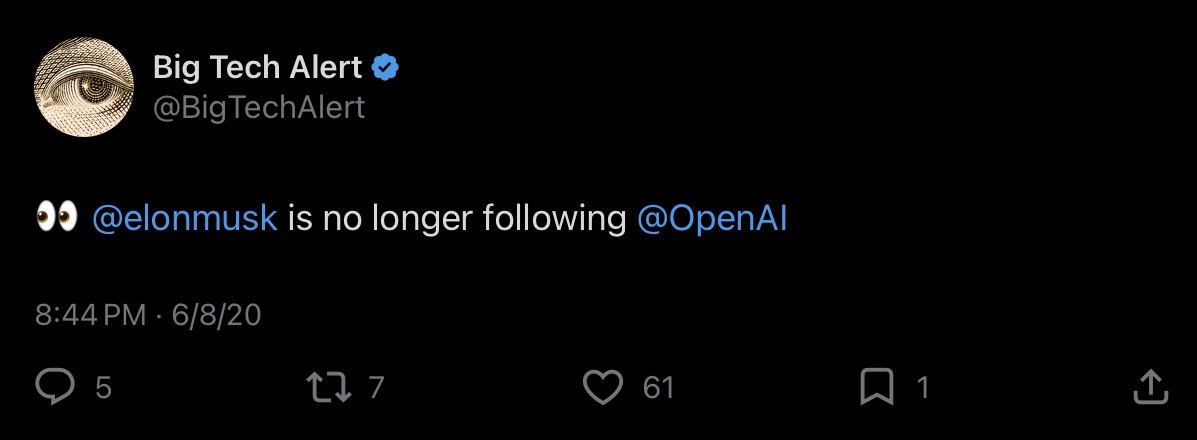
what incredible material for the future historian! by tracking this on even more fine-grained levels - they won't be constrained in attention, they'll be able to deeply analyze every 100-follower lowbie - future historians can construct a real biography of the AI scene. and AI really needs this - despite seemingly being "locked up" in the labs, huge advances have been made in this distributed network. 4chan gooners came up with chain of thought, which led directly to RLVR.
you could imagine future historians running simulations just over social media, "wargaming twitter", trying to fill in the gaps of deleted-account wabi sabi and doing leave-one-out runs to understand how important to the discourse each player really was.
the future probably won't carve up the present like we do. we think of things in terms of our experiences and shrink the past. we live in the shadow of the industrial revolution, so we collapse that ~150-year period of history into a single "revolution," a single moment. more careful historians pick apart the "first industrial revolution" (e.g. steam engines), the "second industrial revolution" (e.g. railroads and electricity), and so on. but even this is combining large stretches of time and technological diffusion across space, involving many technologies with different effects, into a single event named after the fact.
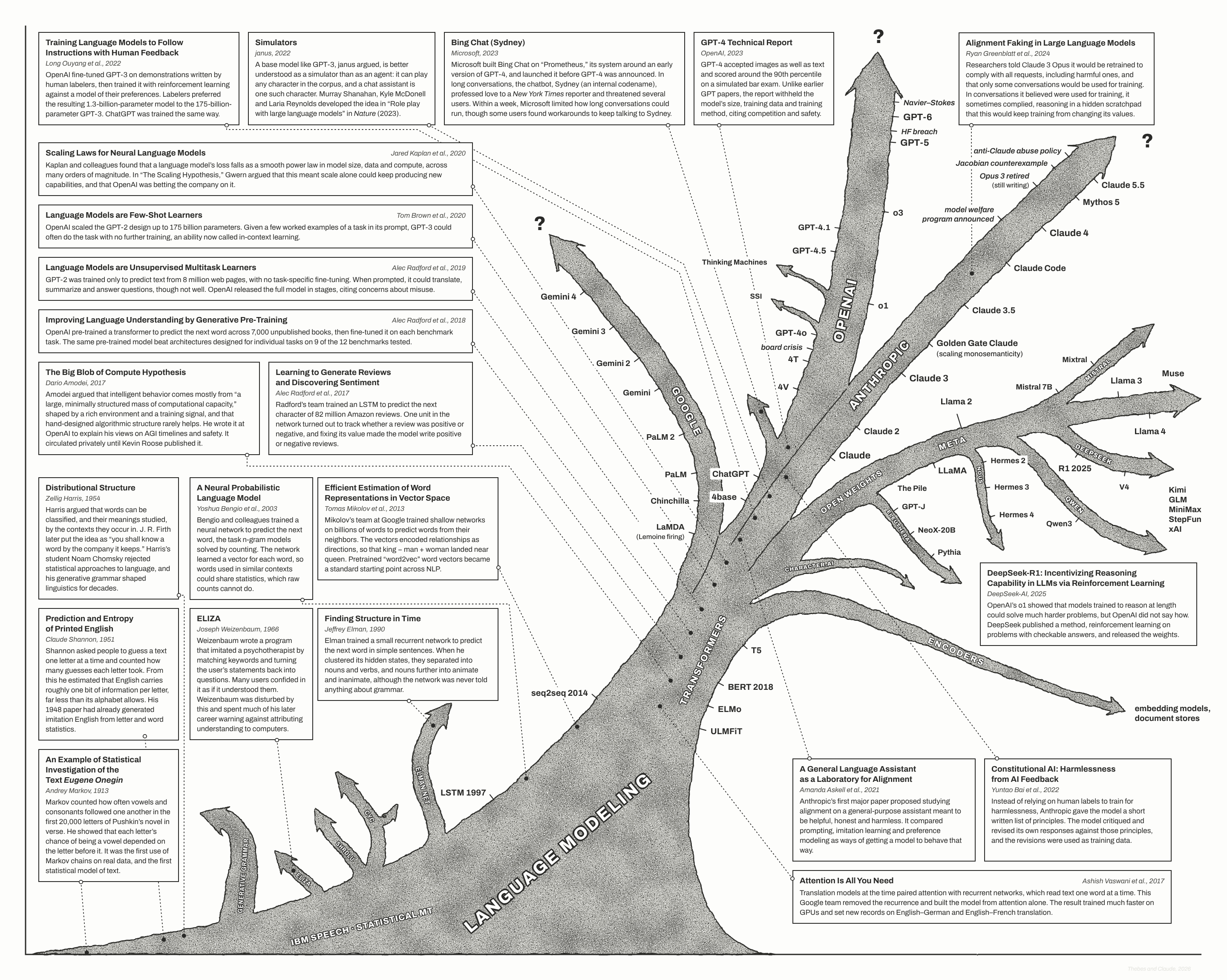
likewise, we remember being on the computer before social media, and on social media before AI, so each of those stages feels like a separate thing to us. but to a future populated overwhelmingly by beings that have only experienced the future, why would these boundaries be salient? if AI comes to dominate the notion of what a computer is and what it's for, which seems likely, it's easy to imagine projecting that future stance back to the beginning of the computing project. the turing machine goes hand in hand, after all, with the turing test. moore's law for the growth of computing power per year and moravec's use of the same to forecast human-level ai becoming possible in the 2020s are easy to conflate. if LLMs eat the future, the entire history of computing might be recast as the history of language modeling:
or as Clarke once put it:
If man survives for as long as the least successful of the dinosaurs-those creatures whom we often deride as nature's failures-then we may be certain of this: for all but a vanishingly brief instant near the dawn of history, the word 'ship' will mean- 'spaceship.'