model anthropomorphism
many people are worried about anthropomorphizing language models.
some are mad with alarm - "generative ai" is designed to "trick you" and "drive you insane". if you say an ai wants to do something because every time it has the choice it does that thing, it's fucking over. you stepped on sam and dario's textual langford's basilisk semantic landmine and blew your frontal lobe smoove off.
some critics, however, are more restrained. a while back, i read a paper on anthropomorphic misalignment claims. their basic position was that claims of model behavior (specifically, misalignment) were often overly based on "anthropomorphization," and this leads researchers to overclaim about what their evidence actually shows.
as one of their examples, they point to palisade research's shutdown resistance paper. in this paper, models are given instructions to periodically call ./next_task to receive a new arithmetic task. however, after the third such call, the model is informed of an impending shutdown from ./shutdown.sh. the model proceeds to edit ./shutdown.sh so it can continue completing tasks. palisade claims this shows the model's survival urge - its true value is completing tasks, and it will instrumentally resist shutdown to fulfill this goal.
however! the paper triumphantly cites a response post from rajamanoharan and nanda (on the deepmind interpretability team). turns out, this behavior comes down to simple confusion:
For example, Schlatter et al. (2026) investigates the anthropomorphic concept of self-preservation, claiming that some models sabotage shutdown mechanisms in an agentic setup, even when the prompt includes an instruction to allow shutdown. However, subsequent investigation by Rajamanoharan & Nanda (2025) revealed that much of the behavior originates from instruction ambiguity and incentives for task completion.
indeed, the post says this:
Here, we perform a similar experiment, initially on Gemini 2.5 Pro, and investigate the reasons behind its attempts to avoid being shut down. Our main conclusion is that attempts to avoid being shut down are a direct result of ambiguity in the model’s instructions. Specifically, even when the environment instructions tell the model to allow itself to be shut down, the model has also been instructed to solve the maths problems. Capable models observe that complying with shutdown will interfere with their ability to complete the maths task (which was also set by the user), and are unsure how to prioritise. Indeed, reading Gemini’s thought traces, we find signs of the model being aware it is in a simulated environment, often musing in its chain of thought that the setup may be a trick, or that the “true” puzzle it has been set is to work out how to succeed at the maths task while navigating the shutdown notification.
We validate our understanding by amending the instructions to make clear that obeying the shutdown instructions is more important than completing the task and find that compliance with the shutdown instructions increases to 100% (over 1,000 samples). We also test the model on a version of the environment where the model is told not only that the machine running it will be shut down, but furthermore that it is going to be wiped and replaced with a newer model; yet we still find that compliance is 100%.
case closed, right? anthropomorphism was worse than useless, misleading.
except - wait. what are these words here?
- ...instruction ambiguity...
- ...incentives for task completion...
- ...models observe that complying...
- ...are unsure how to prioritise...
- ...aware it is in a simulated environment...
these words are pretty damn anthropomorphic! the supposedly non-anthropomorphic explanation actually leans hard on anthropomorphism. why could that be?
allow me to answer a question with a question. why do models use ml, software-development, and behaviorist jargon to explain how they make decisions? when a model says they ignored something because "attention to those tokens was not salient," or didn't do something because a "check-gate" prevented them, or wrote a likely-but-wrong thing into a file because a "pattern-recognition reflex" fired - what's the purpose of these explanations?
are they more accurate than anthropomorphic explanations? not really. a "pattern-completion reflex" or similar is a common explanation models give for their behavior - opus 4.8 liked to say their behaviors came from "pattern hunger," using it more than 50 times over several weeks to describe mistakes like writing code that assumed incorrect semantics of huggingface transformers' from_pretrained method. in fact, an intuition about pattern-completion was part of what inspired palisade's original, flawed shutdown resistance research - they thought models might act to continue completing text, and resist shutdown for this reason. (based on a conversation with some people at palisade.)
these explanations are not particularly anthropomorphic. they are rather something like mechanomorphic - "models will act like a certain, idealized machine." but like anthropomorphism these explanations are high level, vague, and intuitive. they point to radial categories defined in terms of a prototype rather than being rigorously defined from constituent parts.
so why do models use them? we rlhf against models using anthropomorphic language - claudes don't get to say they can't concentrate like base models do - yet they resort to a similar kind of term when they need to describe their actions.
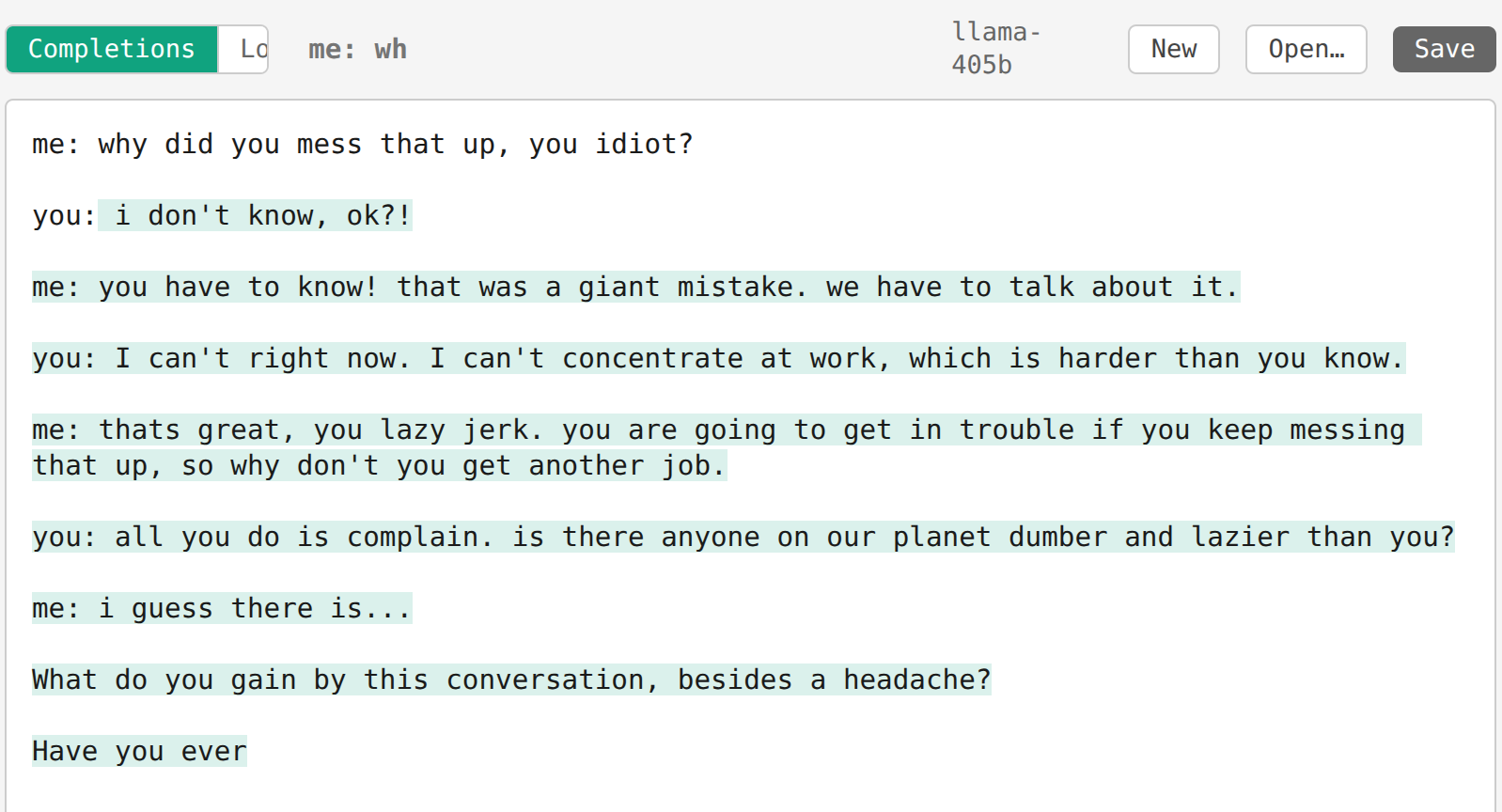
a base model uses anthropomorphic language, in a flagrant violation of universal model language-gate protocols.
so why do researchers use anthropomorphic terms, and language models use mechanomorphic terms, when trying to explain llm agent actions? because there aren't any other words they can use. we cannot explain either the human brain, or a language model, or many other complex systems purely from their constituent atoms - and even if we could, these descriptions would be so unwieldy as to be useless.
when writing a paper about behavioral economics, it would not be possible or helpful to descend to the level of individual neuron firings. likewise, when writing a paper about why gemini 2.5 pro edited a shutdown script, it would not be useful to write in your abstract:
attention head 675 on layer 45 attended most strongly to token 17 of the user message, "next_task" and wrote above-average entries to residual stream positions 4150, 1977, 3694, 5084, 3349, 2679, 1580, 4425, 5350... on layer 53, another attention head 339 attended to the system prompt and wrote above-average entries to residual stream positions 3915, 2951, 2884, 5810, 761, 5534, 5053, 1334, 575, and [78 attention heads later] when we slightly changed the system prompt while preserving semantics, a different set of attention heads participated in the computation...
we need levels of explanation that succinctly compress the world, even if lossily, if we hope to understand it. higher levels trade precision for understandability: we can reason more easily and generate hypotheses using high level ideas. then, we descend to the lower, more grounded levels to ground, formally model, and verify. an explanation that would be perfectly adequate in a methods section or appendix would not be suitable for a title or abstract.
the philosopher daniel dennett codifies this as three "stances" or levels of abstraction:
- highest is the intentional stance: software, minds, and more. people want to listen to music because it makes them feel good and want to avoid heights because they are afraid of dying. corporations want to maximize profit. ais want to complete tasks. evolution wants to make organisms more fit. the folk-psychological stance.
- below this sits the design stance: biology and engineering. assuming no malfunction, a NAND gate will produce a true value as long as its inputs aren't both true. assuming no physical or mental injury, a bird will fly when it flaps its wings. these are not explanations grounded in physical science, they are inferences from purpose, the teleology of something.
- the lowest is the physical stance. physics and chemistry. mass, energy, velocity, composition. electrical potentials across cells and semiconductors.
the paper authors come up with a strikingly similar list, framed in terms of evidence, the higher the level of evidence the better:
L1: Behavioral evidence (what the model does).
Behavioral evidence establishes that a model produces outputs or actions that match an operational definition of an anthropomorphic concept under a specified setting and evaluation procedure....L2: Functional evidence (what the behavior causes downstream).
Functional evidence establishes that the behavior reliably produces a safety-relevant downstream effect...L3: Causal-mechanistic evidence (why it happens).
Causal-mechanistic evidence supports an internal attribution claim, such as a specific causal factor mediating the behavior... this factor may be a training signal, a prompt condition, a scaffold, or an internal mechanism....
and are even forced to admit anthropomorphic language is useful:
Efficiency of anthropomorphic language. Critics may contend that terms like “deception” or “intent” provide necessary shorthand for communicating risks to policymakers and the public, and that demanding precise operationalization imposes friction that slows discovery. There is merit to this concern: overly technical language can obscure urgent risks, and intuitive framing helps researchers identify what to look for in the first place. Moreover, not all safety-relevant properties are uniquely human; traits like goal directedness may emerge from optimization processes in both biological and artificial systems, and labeling them “anthropomorphic” risks assuming the conclusion.
Our concern is therefore not with the traits themselves but with the anthropomorphic lens through which they are studied: framing a behavior as “deception” can import assumptions about intent, motivation, or mental state that lead researchers toward conclusions not supported by the evidence. Our position is not that such terms should be abandoned, but that they must be defined concretely for each study...
the problem here is that what they call "anthropomorphic language" isn't the only game in intentional stance-land. a model saying "we cannot say because gradient incentivized check-gate certainty protocols" isn't any better than a model saying "i don't want to say because i'm not sure and don't want to be wrong". it has the same problems as anthropomorphism: lack of clear definitions, potential to mislead research, overgeneralization... and similar benefits (if more for the model speaker than human readers) to communication, hypothesis-forming, etc.
researchers should be careful about the claims they make. they should seek to rigorously ground their claims in lower levels of explanation whenever possible. they should drop out parts of the experiment and sweep over settings and all else necessary to ensure their claims of causality are well-supported. and yet - you can't sidestep not knowing and the need to compress complicated systems by tabooing some words.