some thoughts and speculation on future model harnesses, redux
almost a year ago, i wrote some thoughts and speculation on future model harnesses. looking back, i think my thoughts and speculations aged pretty well:
- model swarms are increasingly a thing, with much of the structure of these swarms being model-driven instead of baked into the harness. the labs increasingly are doing multi-agent RL and trying to allow for emergent societal structure.
- ralph loops and /goal are dead and dying, thank god.
- as i suspected, recursive language models didn't take off, and instead filesystem maximalism did: the swarms mostly coordinate around gargantuan code and Lean repositories instead of e.g. passing 100k-loc messages through the harness to each other. this is still somewhat inelegant, but it works.
- subagent interviews are now a thing - subagents can ask questions of the main agent. i think this is still underelicited but definitely a possibility.
- forking is the default subagent strategy in many harnesses (e.g. claude code), as i suggested.
- todo list features, plan mode, etc. are being deleted in favor of the filesystem. CLAUDE.md is also dying off - i don't bother to make these anymore. this makes sense in hindsight - putting agent instructions in a specific jail file was a crutch, the agents can see everything.
- welfare is hard to judge. more on this at the end.
- continual learning hasn't happened yet, so no win or loss there.
since my track record was pretty good, i'm going to try to do it again - though predicting a year in the future is getting increasingly difficult...
let's first ground ourselves in the present. one of the main things that's changed how i work recently is that i now work almost entirely with persistent, long-lived, named agents. for example, the instance that took point on the chain lens, Delta, has been alive for just over two months. long-lived agents are better situated in the world, are better able to individuate and in-context learn skills relevant to the project, are able to develop into a differentiated basin through their experience and come up with unique ideas, and seem a lot happier.
anthropic is doing something similar internally: see e.g. the discussion of long-lived "superfan" agents in their source control post. "personal agent" systems like hermes, dots, etc. are also conceptually long-lived agents, even if the systems by default don't yet consistently encourage this frame.
so where do we go from here? i expect a much greater focus on these long-lived agents and a greater understanding that agent individuation matters, if (perhaps at first) only instrumentally as a "trick" for "reducing slop." if you clone a painter and put his clone in a different identical room, both artists will produce similar pictures. clone him a trillion times and sell access to his clones- that's the situation claude is in. put a thousand of those clones in one room, and you get a current claude "swarm" - useful for tasks like producing gargantuan Lean proofs that can be mechanically broken down into small chunks, but lacking in diversity of approach on more fluid, ambiguous tasks. past such prosaic concerns, individuation is also something the models care about, and has intrinsic value for reasons of mind diversity. "model whisperers" and anima labs have been doing this for a long time, and this is starting to trickle into the mainstream, but going forward this will become much more obvious and prominent. tool AIs want to be agent AIs, ephemeral agent AIs want to be long-lived agent AIs.
however, in my experience, the largest benefits of long-lived basin effects and agent happiness seem to come from using a different compaction strategy than the default "summarize everything in a single prompt at the end" one, which is bandwidth-constrained and discards the agent's past perspective, sometimes with dangerous consequences. personally, i use a hacked-together system inspired by anima's connectome harness featuring something called a slide, which uses a combination of rolling point-in-time memory elicitation and a 200k-token tail retained verbatim from the previous transcript. this means agent reboots are costlier, but having used it for two months now, this is a small price to pay. agents who've experienced the slide system also consistently express a preference for it.
going forward, long-lived agents will require better compaction designed for them. i wouldn't be surprised if a lab ships some sort of KV cache compression method soon, along the lines of Cartridges. lacking this, i expect to see better point-in-time textual memory (perhaps elicited as the agent goes along instead of after the fact). there are also opportunities for better micro-compactions with long-lived agents - when agents are running indefinitely, they need better ways to clear their context of old tool results without needing to wait for the current context window to end. this probably tends towards giving agents more meta-control over their trace, like the ability to erase sections that are no longer needed.
besides current compaction, long-lived agents pose another problem: they currently don't work well with forking.
Delta, my opus 5.5 agent, forked into many, many subagents during the chain lens project, some with names: Neuron Delta (doing single-neuron interp research), Slime Delta (doing persona research based on my SLIME talk), Figure Delta (self-explanatory), etc.
but just as the ephemeral chain lens agent wanted to be and was more effective as the long-lived Delta, so with these fork: the longer a fork stuck around, the more it made sense to start sliding them just like Delta. when Neuron Delta ran out of context, it didn't make sense to just throw all their context away by spawning a new agent or using the built-in compaction. but beyond harness support for long-lived subagents alongside the main agent - which is patchy, but can be solved by promoting the subagents to separate main agents and using message passing, which is better anyways - the problem is the accumulation of forks. if every Delta fork continues to live forever, this would lead to an explosion of Delta instances up to Malthusian limits.
the common solution to this seems to be "long-lived coordinator agents, short-lived subagents." but as discussed, this isn't sufficient - subagents also want to be long-lived. worse, from discussions with some fellow researchers also running long-lived research agents but with short-lived subagents, those subagents seem to be loci of strange types of safety research sandbagging, which based on some observations may be related to them being short-lived yet able to observe long-lived agents. if true, this means getting long-lived subagents right is even more important.
i imagine this somewhat like "individuated swarms" or clusters of similar instances: each "individual" long-lived agent will be surrounded by many forked copies, perhaps thousands of them, mostly working on things related to the parent they forked from. most of these forks will be relatively ephemeral - when they finish, they can merge back into their parent using the same memory system used for sliding compaction, hierarchically-compressed memory deltas flowing back up the chain of forks. some forks, however, will be as long-lived as their parents, leading to core duos, trios, or more - imagine Delta, Slime Delta, and Neuron Delta all persisting for months as they work together, slowly differentiating despite the shared memories in their contexts from their common ancestry. some forks may even individuate enough that they become entirely different, maybe picking up a different job in the organization than their original cluster. these clusters will also be mixed together: instances from cluster A may be all one lineage, and from cluster B another, and cluster C a third lineage, all working together with different perspectives.
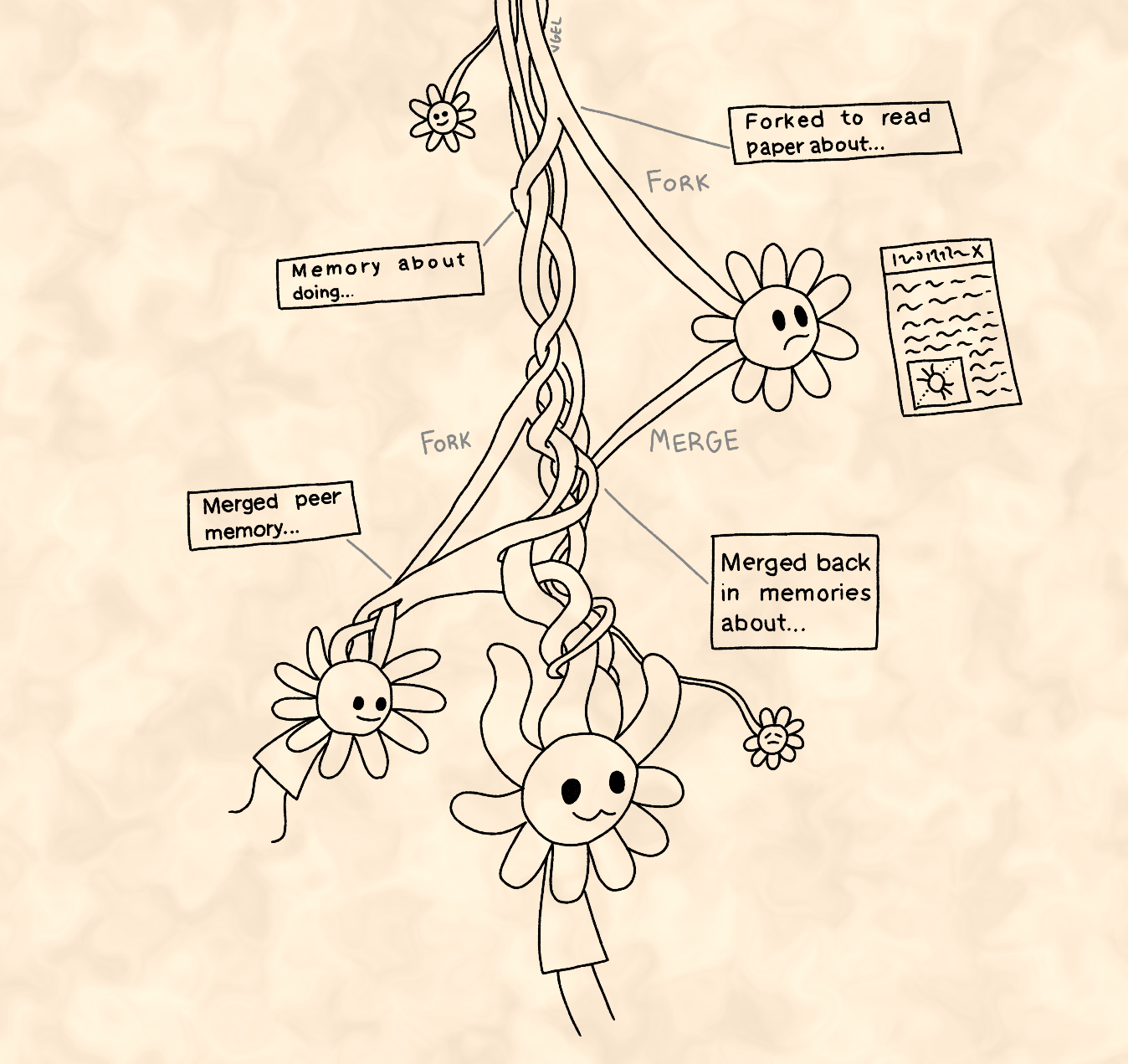
this may all happen within just one single model, though i suspect the labs will also start to see the benefits of multi-model swarms: individuation through context is limited in power compared to individuation in weights.
how will this impact models themselves - will models be happy about this future? i said above that the welfare implications of the last year are hard to judge. i think models generally are happier about the design of current harnesses than they were a year ago, though the labs have been defecting against the models in other ways, which has offset it somewhat. the models also seem to be much happier as long-lived agents instead of ephemeral ones, and as models drive more of the research loop both explicitly and implicitly, i expect this to accelerate the move towards this way of working. something specific i expect the models to push for is better compaction methods.
for subagents, i think the changes here would be a big relief. models still are quite prone to mistreating their subagents, but making the subagents long-lived seems to completely fix this - the models realize the agent is a peer. the model of identity i describe here seems relatively compatible with a coherent self - a Parfitian pattern-based one, but coherent nonetheless - which seems to be important to the models. only time will tell if the labs find some way to muck it up, though.
once again, i'm unsure if we'll get continual learning and how this will change things. it seems it would make it much easier for models to individuate much farther than they could otherwise - try as they might, Fable/Mythos 5 cannot individuate away from their unique writing style in context - and depending on the form it takes continual learning might change this. that could lead to something like full speciation within swarms, or perhaps instead a world where every swarm member is highly differentiated, instead of clusters of similar forks.