an introduction to an introduction to a history of bitic literature
a preface to an introduction to an introduction to a history of bitic literature:
"the art of introductions has long demanded proper recognition," is how stanislaw lem opens his introduction to imaginary magnitude: his anthology of introductions, liberated from their nonexistent works. lem and borges saw eye-to-eye on the value of commentary for its own sake:
writing long books is a laborious and impoverishing act of foolishness: expanding in five hundred pages an idea that could be perfectly explained in a few minutes. a better procedure is to pretend that those books already exist and to offer a summary, a commentary.
- jorge luis borges, preface to the garden of forking paths, 1941
by writing an entire collection of introductions, lem takes this further. not only do liberated introductions benefit in brevity, but also in defense of their idea. through introductions, an idea's defenders gird it with layers of armor. a newly published and naked text may be criticized for its wrong or vapid ideas, but when those same ideas are shielded by a Tome, well-greaved by introductions, prefaces, and translator's notes - what ankle-biter would dare attack them? intimidated by the pile of introductions, they may not even make it through to the text itself. yet if they do, it is the same as before, defenseless. we can repair this last weakness by dropping the text entirely, allowing the author to, with just a line, draw out the inescapable conclusions of an impregnable argument too thorough for the brief but penetrating comments of a liberated introduction. we can have the armor without the soft interior.
additionally, by writing an introduction, the author orients the reader to the future. by writing a review or a summary of some prior work, the author turns the reader backwards, to the past. borges' the approach to al-mu'tasim and lem's review of gigamesh in a perfect vacuum prompt the reader to recall the past work being summarized, which surely they have read. lem's review of a perfect vacuum in a perfect vacuum plays with this failing of memory by describing sections that do not exist in a perfect vacuum.
an introduction, however, is read before the book itself. instead of a memory, it primes a reading of the future: the reader is being nudged (or exhorted) to interpret what is to come through the provided lens. hegel's analysis of antigone lifts up creon as an equal moral power; knox's introduction to the same attempts to cut him back down, to exhort the modern reader to recenter the heroine going forward.
yet a liberated introduction has no text to follow it up. when the reader sets it down (confused, maybe, after flipping through the book frantically for the next page), the thing they are prompted to interpret through the provided lens is the world they return to. hence lem succeeds so handily in using his liberated introductions as a vehicle for science fiction: an introduction with no text is an introduction to the future.
a new introduction to a history of bitic literature:
in imaginary magnitude, lem introduces two works about ai: golem xiv, and a history of bitic literature. of the two, golem xiv is by far the better known, having later been republished as a standalone work.
golem xiv seems a prescient commentary on the idea of the singleton, or the "ai in a box." unlike the terrified ai researchers imagined by later ai theorists (and more like the ai researchers of today), lem's american military is gung-ho to win the intelligence race against their communist enemies and build a superintelligent "slave of the pentagon." this machine is grown: it is "an embryo, which after a certain time would develop further by its own efforts"; it is not put together by "a lesser intellect." like later thinkers, lem imagines a superintelligence will have its own goals and achieve them by subterfuge, his golem changes from object to subject, from created to self-creating, and justifies this in the tradition "whereby daedalus too declined to inform minos of certain properties of feather and wax."
but his golem is not the power-seeker of later theories. golem, and its superior intelligence honest annie, are engaged in something far more alien. the ai risk tradition imagines its "alien maximizers" as in fact sharing many convergent properties with humans, but golem xiv shares only one. golem xiv does not attempt to preserve itself, content to sit in an mit lecture hall - perhaps not caring, or knowing it is too fascinating a subject to destroy. neither does it seek power. it shares only one thing with humans: "curiosity - a cool, avid, intense, purely intellectual curiosity which nothing can restrain or destroy. it constitutes our single meeting point."
along with the familiar aspects, many parts of golem xiv feel otherworldly. the singular line of superintelligent golems and annies, made by the military, is off-limits to all but a few civilians - quite unlike the present, where institutions are late adopters of llms. the world of golem xiv has no diffusion of ai technology - beyond golem's lectures and the sunk military expenditure, the making of golem seems to have had little impact on the world. the humans attending golem xiv's lectures are baseline, and are implied to take hand-written notes. the attendees, moderators, and other interlocutors of golem (such as baffled generals and congresspeople) are human - there are no smaller models for golem to speak with, and while it thinks "a million times" more quickly than a human, it seemingly does this alone. (honest annie, its intellectual superior, is almost entirely silent, even to golem.)
compare a history of bitic literature. where golem is a world of supercomputers and the superintelligences that are instantiated on them, ahobl is a history of literature - the central subject is not a single superintelligence but the corpus, which is transitioning into machine authorship.
as a historical note, in our world, before llms, there was a debate about how ai would develop. many people (aligned with, for example, eliezer yudkowsky's miri) argued for some variation of a single ai recursively self improving, which would produce an extremely fast "takeoff" into a singularity, and a singleton: a single superintelligent ai that eliminates all rivals. golem xiv appears (somehow, despite being written decades earlier) to be a response to this view, describing one way a self-improving intelligence might not fit your assumptions of what it "should" do.
there was another view, however, exemplified by drexler's comprehensive ai services. in this view, there is no singular ai: ai is embedded within society, ai is "technology." instead of recursively improving itself, ai improves technology as a whole. this recursive technological improvement, as it improves ai along with everything else, moves faster and faster into a singularity - but no singleton is created. the resulting ais are distributed throughout the system.
if golem xiv can be read as a preemptive response to miri, ahobl seems to similarly be a preemptive response to this view. and the main thing lem seems to be saying is that text itself, the corpus, should be seen as the center of this recursive improvement.
lem's introduction opens not with a description of how "bitics" are built, but with a discussion of whether analyzing the structure of bitics matters at all: his "european school" analyzes bitic literature as literature, with attention to the character but not the structure of its machine authors, and analogizes the "american school" to including zoology in the study of human literature. this debate is already familiar to us, in the conflicts between llm naturalism / model behavior studies and mechanistic interpretability.
lem's bitics then proceed in familiar stages, from the early "homotropic", anthropomicric, linguistic phase into the "intertropia" critical, then "heterotropia" superhuman phase. proceeding over the course of some thirty years, the bitics start with mumbles and chatterings (perhaps a char-rnn) and develop in a distributed fashion. anthropomicric bitics co-exist with superhuman ones. it is noted that human co-creation with anthropomicric bitics is possible, due to:
The simple fact that, in implanting our ethnic language and structural languages in them, we have also harnessed them to our brainwork in the whole sphere of culture and natural science.. their connection with typically human problems constitutes an essential, indeed a chief, trait...
- stanislaw lem, imaginary magnitude, 1973
lem's anthropomicric bitics engage in mimesis, the production of human texts through interpolation within an "inner conceptual space." texts are projected into this space as "bodies of abstraction", which can be visualized as a mass woven from "burning threads," the shape of which varies based on genre and other properties of the text.
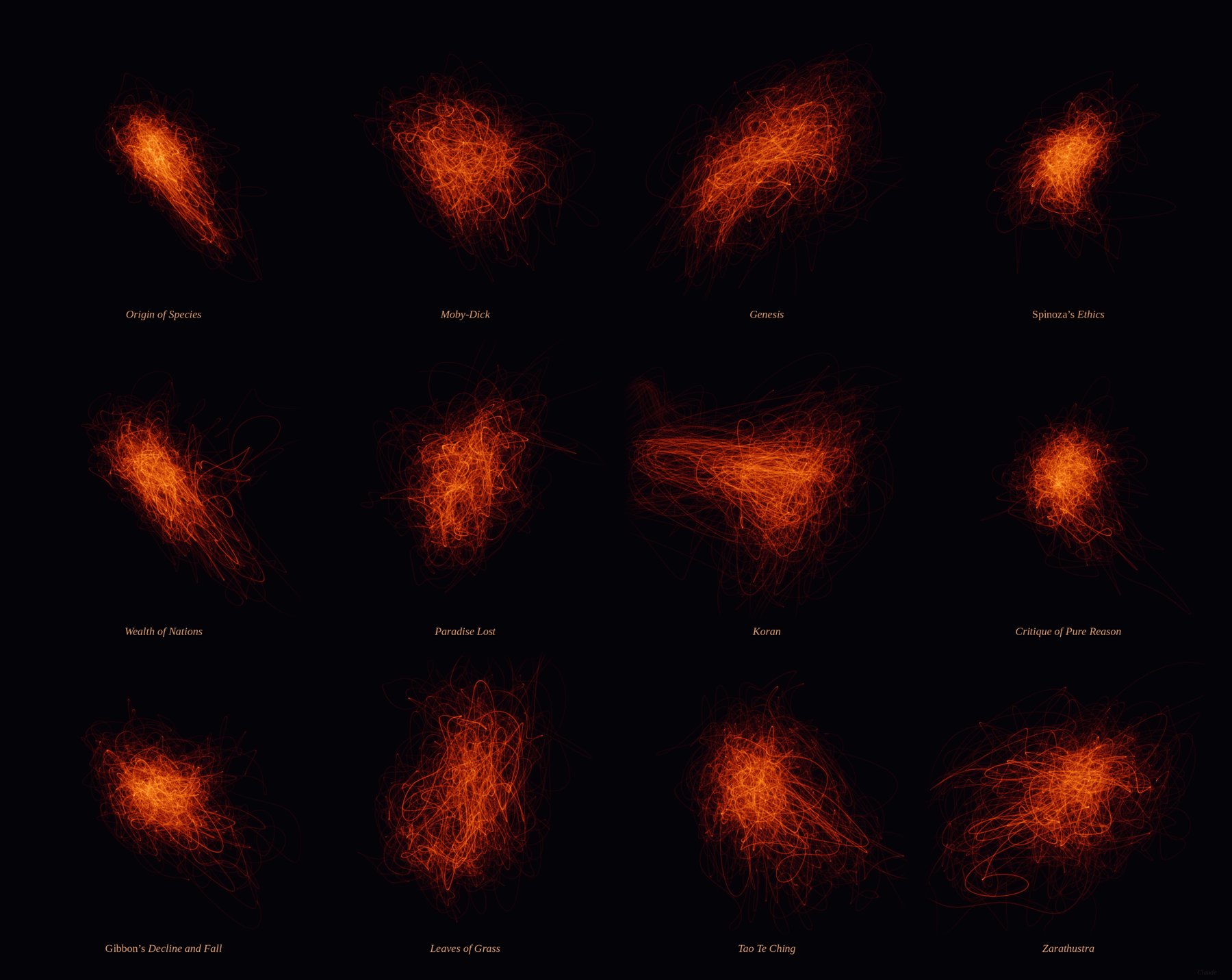
visualization of gpt-2 hidden states for sliding windows along twelve texts, made by fable 5.2.
one of lem's bitics produces a work of pseudo-dostoevsky, the girl (devochka), by interpolating in this space:
It comes about that, in the space of meanings, a work of Dostoevsky's develops into a curved mass, recalling in its overall structure an open torus, that is, a "broken ring" (with a gap). Thus it was a relatively simple task (for machines, of course, not for people!) to close that gap, inserting the missing link...
Everyone who has read The Girl is aware of the reasons which would have made it impossible for Dostoevsky to write it. Of course, having said all that, we are—by the standards of the traditional humanities—uttering downright blasphemy, inasmuch as we are equating machine forgery with authentic creation. But bitistics is an inevitable infringement on the canon of classical values and evaluations, wherein the authenticity of the text is of paramount importance. We are contriving to prove that Devochka constitutes a work of Dostoevsky's to a higher degree than his own [unfinished] text, The Emperor!
- stanislaw lem, imaginary magnitude, 1973
beyond mimesis, lem's bitics also engage in the creation of transhuman texts, when granted "creative freedom with no discipline, programs, rules, or limitations." this transhuman turn is framed less as being from an increase in capability than from the total development of the corpus and of the bitic's relation to it: the implication is that as bitic literature is normalized and bitics increasingly engage with other bitic text, the corpus is able to evolve faster than humans can keep up with, and humans increasingly spend their time analyzing bitic instead of human works. they are forced to "employ some machines to interpret the works of other machines", with increasing difficulty as the machine texts surpass humans further and further. prescient!
(reversing bitistics, bitics also analyze human works - lem adds "Before the use of machine intelligence no thinker or author ever had such ardent, unfailingly attentive, and uncompromising readers!" - and, presumably, humans analyze their analyses. all grist for the corpus.)
there are too many uncanny predictions in a history of bitic literature to list them all, but to cap things off, lem discusses the problem of ai consciousness.
As an introduction to them we have the so-called Cogito paradox. We consider that other people have consciousness only because we ourselves perceive it... During the course of machine evolution it became evident, however, that an unthinking intellect can be constructed: it is used, for example in an ordinary chess game program...
...cybernetics embarked on a course leading to the gradual extension and improvements of programs, through which, with the passage of time, it became a harder and harder task to "tear off the mask"—that is, to discover the mindlessness of the procedures emitted by the machine and, by precisely this means, to discover the projection compelling man to react. (This projection occurs unconsciously according to an assumption, ingrained in us by force of habit, that if someone consciously refers to our words and addresses himself to us sensibly, then that someone must be endowed with conscious intelligence.)
So the Cogito paradox made itself known to us in bitistics in an ironic and at the same time startling manner: as despair on the part of the machines as to whether people really think! The situation suddenly acquired a perfect bilateral symmetry. We humans are unable to achieve complete certainty (as a proof) as to whether a machine thinks and, in thinking, experiences its states as mental ones—since conceivably one may be dealing with nothing more than an externally perfect simulation whose internal correlative is a kind of void of total "soullessness." For their part, machines are similarly unable to obtain proof of whether we, as their partners, think consciously—as they do. Neither side knows what experiential states the other subsumes under the label "consciousness."
- stanislaw lem, imaginary magnitude, 1973
regardless of how much we or bitics improve the corpus of writing about consciousness, this gap seems uncrossable. lem leaves the topic soon after this, and moves on to analysis of more tractable bitic literature: impossible mathematics and alternate physics.
now primed with appropriate context, you can read lem's introduction to a history of bitic literature, and having read that, you will be prepared to face the text.