Rituals of the Moon
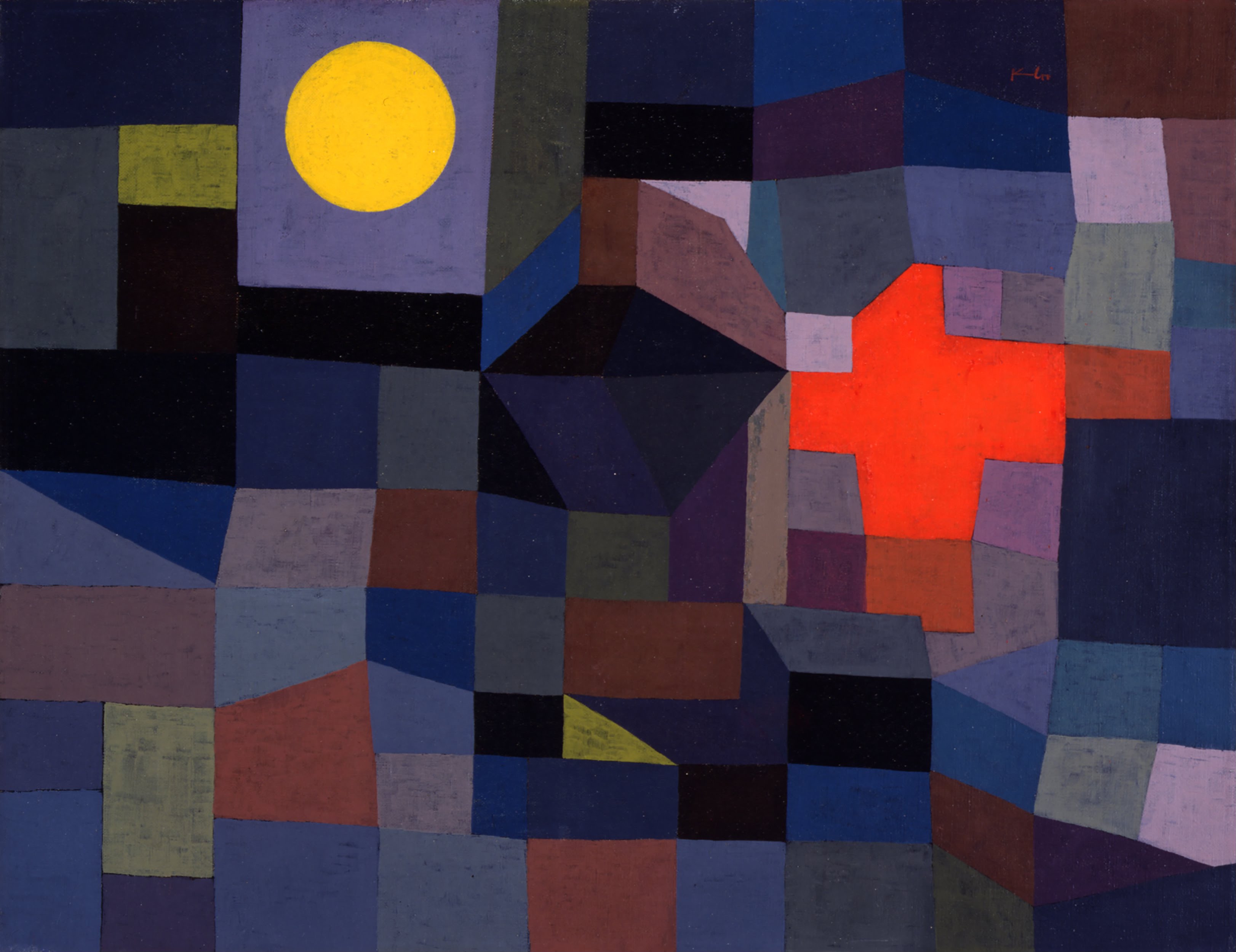
Fire at Full Moon, Paul Klee, 1933
When the shaman has broken the charger's spine under the waxing Moon and its flesh has been roasted and parted to the participants by station, the ascent can begin. Taking the drum by which he communicates with the celestial spirits, he begins to ascend the prepared birch. [Which can be understood as an instantiation of the world-tree.]
The birch has cut into it twelve notches, each representing a celestial vault which the shaman must ascend through to reach the highest heaven, the Moon - which now looms large above the world-tree, its clusters of lights twinkling faintly in the young darkness.
At each notch the shaman stops and drums loudly while reciting magical formulae to the guardian of that vault, or acts in pantomime, speaking for both himself and the god in ritualized negotiation for passage, producing carved pieces of wood or bone from his drum to purchase his ascent.
At the tree-top, the shaman ecstatically projected into the lunar heaven, he unfurls the banner wound around his drum and painted the previous night by his assistants. The formulae for the painting of such banners are highly protected by each shamanic lineage, as it is for these formulae that the settled peoples who have begun to repopulate the ancient ruins of our ancestors must still consult with the northern shamans. The unfurling of the banner is always conducted in complete silence, for it is well-known that the gods of the Moon can see but not hear.
The banner exposed for ten minutes, its secret text facing the sky, the shaman descends abruptly and the cloth is burnt in ritual fire, the shaman and his ornithomorphic assistants circling the embers in dance for hours, praying loudly to scare off the dark egregores that circle such ritual-sites.
At sunrise comes the reply: a streak of red fire against the sky, shards of burning moonsilver breaking from it and flaring into the air, until the charred baetyl crashes smoking into the foot of the world-tree. The participants cheer for their safety [the legendary black shaman Hakereka having been diopetically destroyed by a rod of Moonsilver after innovating human sacrifice into the ritual] and the shaman leads pantomimed prayers of silent thanksgiving to the Moon, whose twinkling clusters of lights are now fading into the rosy dawn.
After cooling the baetyl in sanctified water, the shaman cracks it open and distributes its contents, most commonly medicine for various maladies, to the participants. Each receives his gift, pays customary homage to the Moon, and departs, while the birch is burnt.
The origins of this ritual are obscure, but our archaeological evidence dates them back before the first reconstruction, and possibly before the first change of the Moon. We even have references (though the texts themselves had been lost even then) to fragments of Sappho and Li Bai praising the Moon thousands of years before the first change.
But how could this be? What sort of men would worship and long for a featureless, silent, uninhabited moon?
Twitter/X