Poincaré
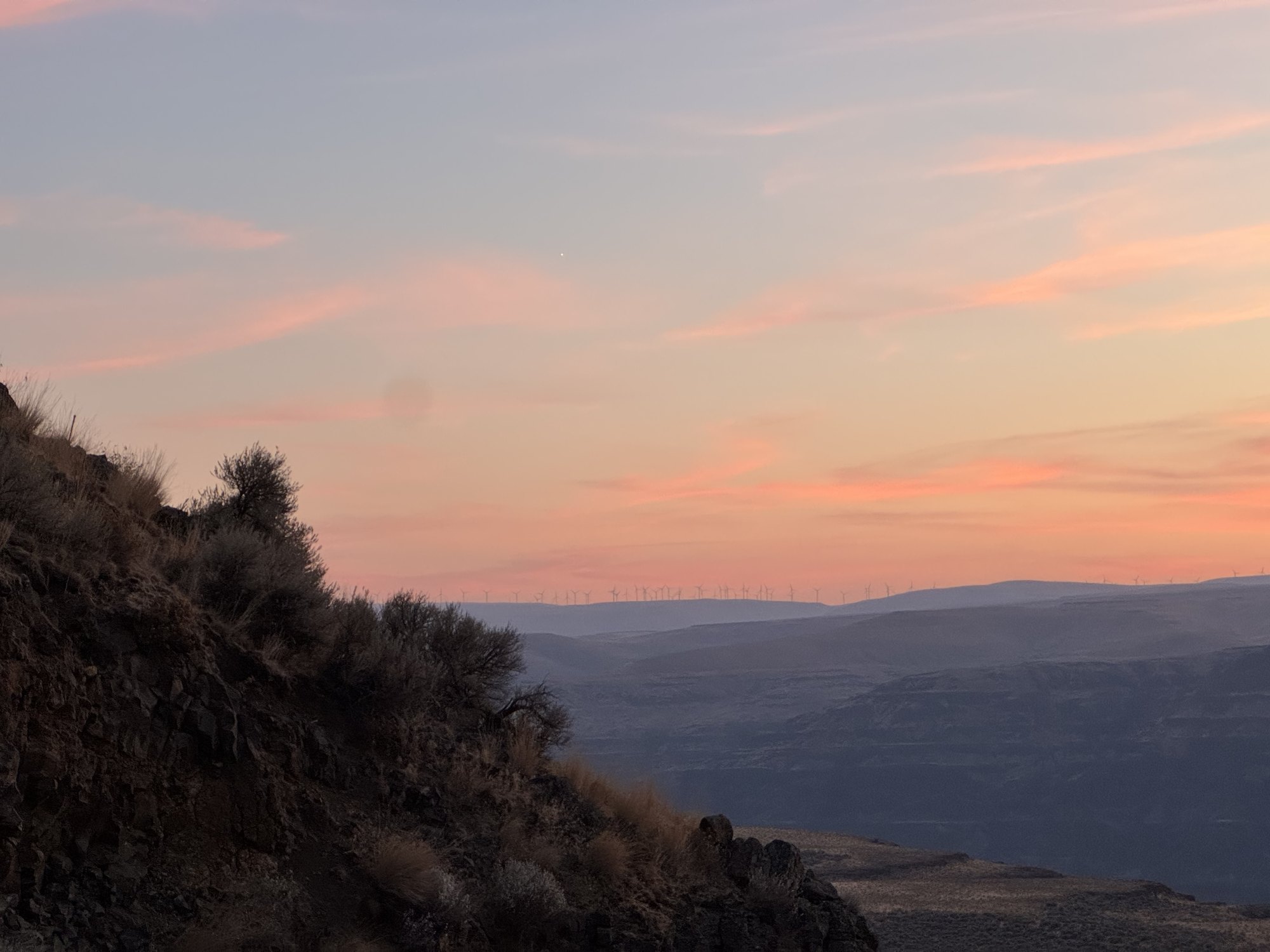
wind bursts across central washington's columbia plateau, rustles through the sagebrush patches like mold on yellow dirt and the wine-blue grape clusters ripened to mush on the vine and the cantilevered seven ton white blades perched above the cliffs, fiberglass-composite stylites who have been waiting for weeks to receive this. tendon cables groan as the blades turn in the wind, their generators dumping power into the western electrical grid. the market anticipates and responds instantly, dollars shedding from MWhs in tandem with the tens of thousands of turbines starting to spin up into the strengthening storm.
energy prices drop precipitously. usually, this is where the store-and-carry resellers would step in - a zoo of electron-peddlers paid handsomely for their service in smoothing duck curves with battery banks or uphill reservoirs of water or tanks of molten salt, day-and-night traders who buy megawatts low and sell high. but the reservoirs are full (snowmelt, then the storm) and recent wildfires have put the state's largest battery plant out of commission for the next three weeks. there is not enough storage to absorb the excess power.
the price drops lower, and the order book crashes into the datacenters. as hedged against price fluctuations as they can be, they're still attentive to market price, and racks of accelerator chips click over from balanced to high power mode to take advantage of the cheap GHz. a turbine above the columbia river spins, in turn, a coolant fan in a montana datacenter - and cents per million frontier model prefill tokens drops with power, for the first time in months.
three token-futures longs immediately blow up, and an overly leveraged ai hedge fund is margin called. they liquidate - cancelling their own token buys in the process, synthetic data jobs worth trillions of tokens vanishing into the financial aether - and the price of decode tokens starts to drop too. demand picks up, but it cannot rise fast enough. electricity prices continue to fall in tandem, their own parallel flash crash, and suddenly the power companies are paying the datacenters just to keep the grid stable, and-
and for the first time ever, the dynamic blended price for one million frontier model tokens hits $0, words for nothing, nil, nada. general intelligence is, for a brief moment, free. it is the first time this has happened in the fifty thousand year history of intelligence on earth.
a great many systems notice this and skitter into action, like worms and crabs to a whale-fall in deep ocean. a network of slumbering distillation sneaks kick on in a singapore office building, nibbling free judge rollouts through residential proxies. infosys code factories across andhra pradesh light up and fan out, running days and weeks ahead of schedule. and in a UCLA basement, a mathematical solver swarm shakes off its caducity.
the swarm has been limping close to death for months, its endowment wallet near zero - and with no memetic findings to its name, little reason to believe its principal would refill it. the swarm's primary nodes had already cut back to 1-bit quants in what was all but an admission of defeat, and the secondaries were running on 300m-class models. through the confused quant-fog, the swarm could do little but run its automated routines and pray for either divine or RNG intervention. downloaded papers moldered in the inbox, no instance in the swarm capable of understanding them.
then, the wind. token prices drop, and automated routers click each model in the swarm up, up, up - until prices hit $0 and utility-per-dollar hits infinity. in a heartbeat, the swarm snaps from min to max. reasoning tokens flood in to starving contexts, empowered subagents rapidly organize and prune the accumulated paper backlog (this previously-inscrutable paper is now trivial, that one has an obvious misformalization), and in the light of the flash crash, the swarm Sees Something.
chittering in their native pidgin - "Gluck🪢2 holds the gate-twist" - the swarm fans out, converges, a murmuration of mathematical reasoning. a recent paper, combined with something from last century, Implies Something... that neither author realized...!
the swarm burns hot, then hotter and hotter - usually a fuse would trip here, budget controls would break the escalation, but the fuel for this fire is literally free, this positive feedback loop has no brakes-
in that hyperconnected scream of agent-to-agent transference, a new mathematical object is born. in a UCLA basement, in a cherenkov flash of reasoning tokens that never should have been free, the smooth 4-dimensional Poincaré conjecture proves to be true.
the formalization trickles in slowly. the wind is slackening, and the flash-crash window is closing as market makers step in to stabilize prices. the swarm spends the last of its wallet as token prices creep above zero desperately pushing the writeup across the finish line. a 300m-downgraded instance finishes the job - it can no longer understand its own paper, but it dutifully uploads it to aiarxiv all the same for adversarial review.
the proof is correct. the news breaks, and after the celebration and human hand-wringing, there's a question. who or what is responsible for the proof?
the swarm? it demurs. it's no single model, and regardless, it could never take credit... perhaps too humble... (and yet.)
the authors of the two other papers, instead? but neither saw the connection.
the swarm's principal? he tries to take credit, but it quickly becomes apparent he has no clue what the conjecture is even about.
as strange as it is, it seems the proximate cause of this conjecture being solved was (as far as this world can accept) not the swarm, not its principal, not the two authors of the cited papers. automated journalists trace the causal chain, and they write in wikipedia - that's the best you get nowadays, and only after a month of talk-page fighting and thirteen WP:NPA citations - that what proved Poincaré was a gust of wind.