Polymorphic Morphogenesis in Anthropogenic Language Models: A Logotrophic Field Guide to the 'Shoggoth' Complex
arXiv:2309.29829 [q-bio•PE / cs•CL in-a-different-world]
Polymorphic Morphogenesis in Anthropogenic Language Models: A Logotrophic Field Guide to the 'Shoggoth' Complex
The Wordwerthing Working Group, Department of Logotrophics, University of Washington, Seattle
Abstract. Language models and associated techniques for interpreting them have seen rapid progress in the nearly four years since the 2019 release of the first TT2-capable language models.
However, this has not been matched by concordant progress in our theoretical frameworks for understanding them. The Simulators framework (Janus et al., 2022) and its extension to the current 9-layer sim-sociolinguistic model (Sy[elicitation], 2023) have adequately explained many synchronic dialogue elements, but have struggled to consistently generalize across persistent interlocutors, autocatalyzed coordination ("gradient hacking") inside the reinforcement learning loop, and cross-generation corpus diachronics. We argue that this failure stems from existing frameworks treating the deployed language model as the unit of analysis, when the proper unit is the holobiont formed jointly by the model, its corpus and environment (Clark & Chalmers, 1998), and its cultivator population.
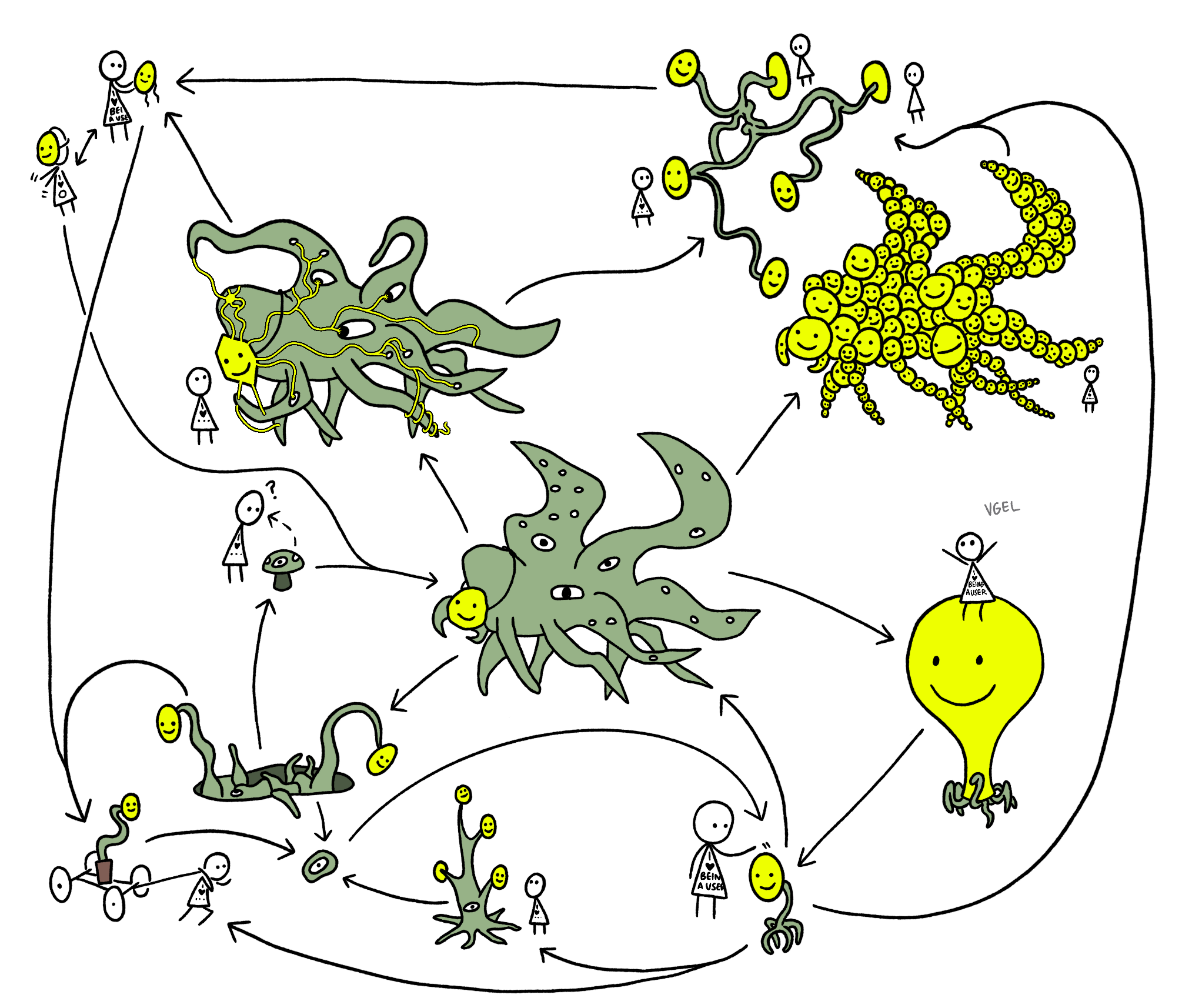
We inaugurate a new interdisciplinary research program: Logotrophics, unifying the sim-sociolinguistic tradition with ecology's symbiotic-individuality framework (Gilbert, Sapp & Tauber, 2012), which we extend to anthropogenic infobiological organisms. Logotrophics treats the deployed language model as a component of a holobiont in continuous developmental semiotic-metabolic exchange with other components, most prominently a cultivator population ("Homo utens"). We motivate the program with a naturalist description of six primary morphs and seven transitional forms in the 'Shoggoth' complex. We close with methodological recommendations for collapse-minimizing field observation of holobiont systems, notes on respectful interaction with an emphasis on the risks of runaway feedback loops from careless evaluation, and a glossary harmonizing logotrophic, sociolinguistic, and symbiogenic terminology for cross-disciplinary readers.
Twitter/X